



News & Updates
Brazed Plate Heat Exchangers: A Compact, Efficient, and Cost-Effective Thermal Solution


Brazed plate heat exchangers have become a preferred choice across HVAC, industrial, and process applications thanks to their exceptional efficiency, compact footprint, and competitive cost. Their design and construction provide high thermal performance while ensuring durability and long service life.
Design and Construction
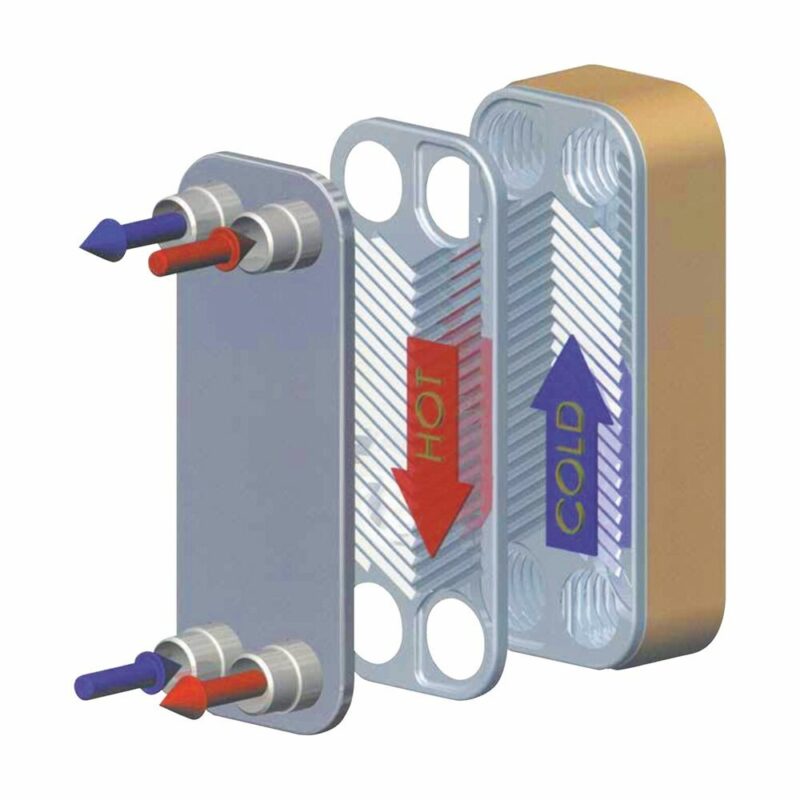
A brazed plate heat exchanger is built from a series of thin, corrugated stainless-steel plates that are bonded together into a single, gasket-free unit. Each plate is stamped into a chevron-style pattern to maximize turbulence and enhance heat transfer.
When assembled, the plates form alternating channels, allowing two fluids to flow in close proximity without mixing. The brazing process—typically using copper or stainless-steel brazing material—permanently seals the plates. This takes place in a high-temperature vacuum furnace, which prevents oxidation and results in a clean, uniform, and highly reliable unit. The absence of gaskets eliminates common maintenance concerns associated with traditional plate-and-frame exchangers.
One of the key advantages of this design is flexibility. The compact rectangular frame can accommodate numerous combinations of plate sizes and quantities, enabling engineers to achieve the required heat transfer surface area and pressure drop using multiple configurations.
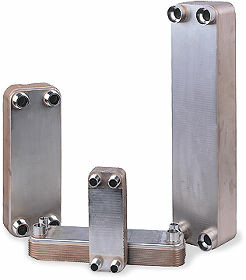
This compatibility between frame sizes often allows manufacturers to maintain inventory that can meet urgent delivery needs. Thermal Products offers both copper- and stainless-brazed constructions. Copper brazing is generally the more economical option and is suitable for many industrial fluids. Stainless-brazed units are ideal for applications involving deionized water, potable water, or processes requiring sanitary conditions.
Superior Efficiency and Thermal Performance
Beyond durability, brazed plate heat exchangers deliver outstanding thermal efficiency. They commonly achieve approach temperatures as low as 2–3°F. The approach temperature represents the difference between the outlet of your process side vs the inlet temperature of your utility side.
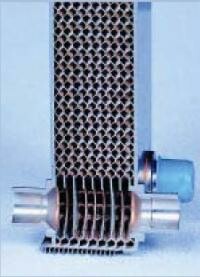
Such tight temperature approaches are achievable thanks to the high heat transfer coefficients produced by the corrugated plate geometry. By comparison, shell-and-tube heat exchangers typically operate with approach temperatures in the 7–10°F range. For example, a shell-and-tube unit supplied with 50°F fluid on one side may only provide 60°F on the opposite side. A brazed plate heat exchanger under similar conditions can achieve outlet temperatures closer to 53°F—demonstrating significantly greater efficiency and performance.
Learn More
For application assistance or additional information on whether a brazed plate heat exchanger is the right solution for your project, contact your local Thermal Products Inc. Sales Engineer. They can provide guidance on sizing, material selection, and performance optimization.